

As manufacturers continue pursuing higher productivity, lower energy consumption, and tighter dimensional accuracy, the Electromagnetic Wire Rolling Mill has emerged as a key innovation in modern wire production. This article explains how electromagnetic rolling technology works, its major advantages over conventional rolling equipment, typical industrial applications, and the factors buyers should evaluate before investing. Whether you manufacture copper, aluminum, alloy, or specialty electromagnetic wire, understanding this technology can help improve production efficiency, product consistency, and long-term profitability.
Contents
- What Is an Electromagnetic Wire Rolling Mill?
- How Does an Electromagnetic Wire Rolling Mill Work?
- What Are the Main Advantages of Electromagnetic Rolling Technology?
- Traditional Rolling Mill vs. Electromagnetic Wire Rolling Mill
- Which Industries Benefit Most from This Technology?
- How Should You Choose the Right Rolling Mill?
- Frequently Asked Questions
What Is an Electromagnetic Wire Rolling Mill?
As global industries demand greater precision and production efficiency, GRM continues to develop advanced rolling solutions that help manufacturers stay competitive. A modern Electromagnetic Wire Rolling Mill combines electromagnetic control technology with precision rolling equipment to produce high-quality wire products while reducing energy consumption, improving dimensional consistency, and minimizing material waste.
Unlike conventional rolling mills that rely solely on mechanical pressure, electromagnetic systems introduce controlled magnetic forces during the rolling process. These forces optimize deformation, stabilize material flow, reduce internal stress, and improve the surface quality of finished wire. The result is a manufacturing process capable of delivering superior product consistency even during high-speed production.
Today's manufacturers face increasingly strict quality standards in industries such as electric vehicles, renewable energy, electronics, aerospace, and industrial automation. These markets require wire products with precise dimensions, excellent conductivity, smooth surfaces, and outstanding mechanical properties. An advanced electromagnetic rolling system is specifically designed to meet these demanding production requirements.
How Does an Electromagnetic Wire Rolling Mill Work?
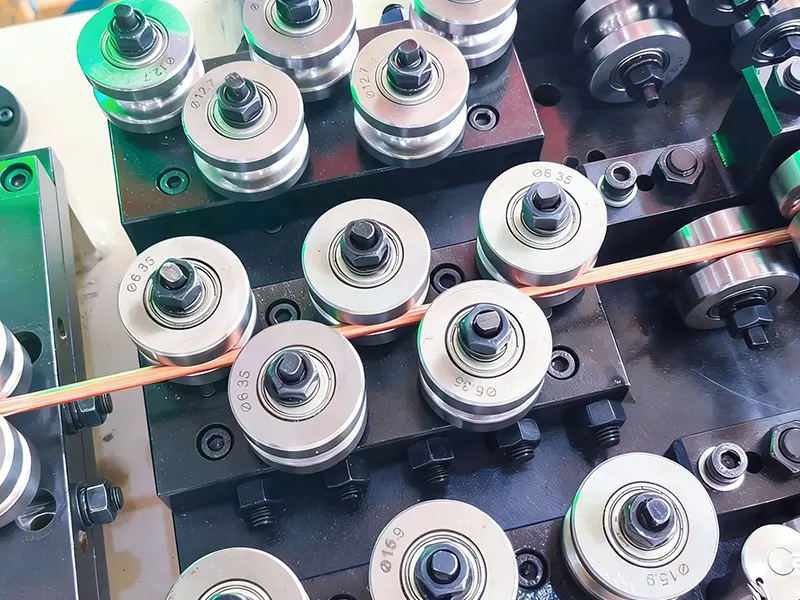
The operating principle combines traditional rolling mechanics with advanced electromagnetic field control. During production, the workpiece passes through precision rolling stands while electromagnetic devices generate carefully controlled magnetic fields around the deformation zone.
These electromagnetic fields influence the behavior of the metal during rolling by improving plastic deformation characteristics, reducing rolling resistance, and enhancing the uniformity of material flow. Advanced control systems continuously monitor rolling parameters and automatically adjust operating conditions to maintain stable production quality.
A typical production process includes several coordinated stages:
- Raw wire rod preparation and inspection.
- Surface cleaning and pre-treatment.
- Controlled heating when required.
- Electromagnetic-assisted rolling deformation.
- Precision diameter adjustment.
- Online monitoring and dimensional measurement.
- Cooling and stress stabilization.
- Automatic winding and final quality inspection.
Because the electromagnetic field can be precisely controlled throughout production, manufacturers achieve more consistent rolling pressure distribution compared with conventional mechanical systems. This improves finished product quality while reducing wear on production equipment.
What Are the Main Advantages of Electromagnetic Rolling Technology?
The popularity of electromagnetic rolling continues to grow because manufacturers increasingly prioritize efficiency, automation, and product consistency. Compared with traditional production methods, this technology delivers significant operational improvements across nearly every stage of manufacturing.
-
Higher dimensional accuracy
Advanced control systems maintain tighter tolerances throughout continuous production, reducing product variation and improving customer satisfaction. -
Excellent surface finish
More uniform material deformation minimizes scratches, surface defects, and rolling marks while producing smoother finished wire. -
Reduced rolling force
Electromagnetic assistance lowers deformation resistance, allowing smoother production and extending equipment service life. -
Improved energy efficiency
Optimized rolling conditions help reduce unnecessary energy consumption, lowering operating costs over long production cycles. -
Better mechanical properties
Controlled deformation contributes to improved tensile strength, flexibility, and fatigue resistance in finished wire products. -
Lower maintenance requirements
Reduced mechanical stress decreases wear on rollers, bearings, and transmission components, resulting in lower maintenance costs. -
Greater production stability
Real-time monitoring enables rapid process adjustments, reducing downtime and improving overall manufacturing efficiency.
For manufacturers seeking consistent quality while controlling operational expenses, these advantages translate directly into increased production capacity, fewer rejected products, and stronger competitiveness in global markets.
Traditional Rolling Mill vs. Electromagnetic Wire Rolling Mill
Selecting the right rolling technology requires evaluating production goals, operating costs, product quality requirements, and long-term return on investment. While conventional rolling mills remain suitable for certain standard applications, electromagnetic technology provides measurable advantages for manufacturers targeting premium-quality wire products.
| Comparison Item | Traditional Rolling Mill | Electromagnetic Wire Rolling Mill |
|---|---|---|
| Rolling Precision | Good | Excellent with stable dimensional control |
| Surface Quality | May require additional finishing | Smoother surface with fewer defects |
| Energy Consumption | Higher | Optimized and more energy-efficient |
| Rolling Force | Entirely mechanical | Reduced through electromagnetic assistance |
| Equipment Wear | Relatively higher | Lower wear and longer service life |
| Automation Level | Medium | High with intelligent monitoring |
| Product Consistency | Acceptable | Highly consistent across long production runs |
| Long-Term Operating Cost | Higher maintenance cost | Lower maintenance and improved efficiency |
For companies producing electromagnetic wire, magnet wire, copper conductors, aluminum conductors, or specialty alloy wire, investing in an Electromagnetic Wire Rolling Mill often delivers a faster return through improved productivity, reduced scrap, and lower operating expenses.
Which Industries Benefit Most from This Technology?
The versatility of electromagnetic rolling makes it suitable for numerous industries requiring precision wire products. As global demand for electrification and intelligent manufacturing grows, these industries increasingly depend on stable, high-quality rolling solutions.
- Electrical cable manufacturing
- Magnet wire production
- Transformer winding wire
- Electric motor manufacturing
- Electric vehicle components
- Renewable energy systems
- Industrial automation equipment
- Consumer electronics
- Aerospace wiring systems
- Medical equipment manufacturing
Manufacturers serving these markets often face strict requirements regarding conductivity, tensile strength, diameter tolerance, and surface finish. An advanced rolling solution helps ensure consistent compliance with these demanding specifications while supporting higher production speeds.
How Should You Choose the Right Rolling Mill?
Purchasing a rolling mill is a strategic investment that affects production efficiency for many years. Before making a decision, buyers should evaluate both technical capabilities and supplier expertise.
Consider the following selection criteria:
- Production capacity and future expansion requirements.
- Compatible wire materials such as copper, aluminum, or specialty alloys.
- Rolling accuracy and finished product tolerance.
- Automation level and intelligent control functions.
- Energy-saving performance.
- Maintenance accessibility and spare parts availability.
- Technical support and engineering experience.
- Installation, commissioning, and operator training services.
- Long-term after-sales support.
Choosing an experienced manufacturer is equally important as selecting the equipment itself. A supplier with extensive engineering knowledge can provide customized production line solutions, optimize plant layouts, and offer technical assistance throughout the equipment lifecycle.
GRM has accumulated extensive experience in rolling mill technology and continues to provide innovative solutions designed to improve production efficiency, operational stability, and finished product quality. By combining engineering expertise with advanced manufacturing processes, GRM helps customers build modern wire production lines capable of meeting evolving market demands.
Frequently Asked Questions
1. What materials can an Electromagnetic Wire Rolling Mill process?
It can process a wide range of conductive materials, including copper, aluminum, copper alloys, aluminum alloys, and many specialty wire materials used in industrial manufacturing.
2. Is electromagnetic rolling more energy-efficient than traditional rolling?
Yes. Electromagnetic assistance reduces rolling resistance and optimizes deformation, helping lower energy consumption while maintaining high production efficiency.
3. Does this technology improve wire quality?
Yes. Manufacturers generally achieve better dimensional accuracy, smoother surfaces, improved mechanical properties, and more consistent product quality.
4. Is it suitable for automated production lines?
Absolutely. Modern systems integrate intelligent monitoring, automatic parameter adjustment, online inspection, and production data management for Industry 4.0 manufacturing environments.
5. Why should manufacturers choose GRM?
GRM offers professional rolling mill solutions backed by engineering expertise, customized system design, reliable manufacturing quality, technical support, installation guidance, and responsive after-sales service, helping customers maximize production efficiency and long-term investment value.
Conclusion
As the wire manufacturing industry continues moving toward intelligent, energy-efficient, and precision-driven production, the Electromagnetic Wire Rolling Mill is becoming an essential solution for manufacturers seeking higher product quality and stronger market competitiveness. By combining advanced electromagnetic technology with precision rolling engineering, businesses can improve productivity, reduce operating costs, and consistently deliver premium wire products that meet international standards.
If you are planning to upgrade your wire production line or would like expert guidance on selecting the most suitable Electromagnetic Wire Rolling Mill, the experienced engineering team at GRM is ready to help. Contact us today to discuss your production requirements, request a customized rolling mill solution, and discover how our innovative technologies can support your long-term manufacturing success.