
- English
- Español
- Português
- русский
- Français
- 日本語
- Deutsch
- tiếng Việt
- Italiano
- Nederlands
- ภาษาไทย
- Polski
- 한국어
- Svenska
- magyar
- Malay
- বাংলা ভাষার
- Dansk
- Suomi
- हिन्दी
- Pilipino
- Türkçe
- Gaeilge
- العربية
- Indonesia
- Norsk
- تمل
- český
- ελληνικά
- український
- Javanese
- فارسی
- தமிழ்
- తెలుగు
- नेपाली
- Burmese
- български
- ລາວ
- Latine
- Қазақша
- Euskal
- Azərbaycan
- Slovenský jazyk
- Македонски
- Lietuvos
- Eesti Keel
- Română
- Slovenski
- मराठी
- Srpski језик
- Esperanto
- Afrikaans
- Català
- שפה עברית
- Cymraeg
- Galego
- Latviešu
- icelandic
- ייִדיש
- беларускі
- Hrvatski
- Kreyòl ayisyen
- Shqiptar
- Malti
- lugha ya Kiswahili
- አማርኛ
- Bosanski
- Frysk
- ភាសាខ្មែរ
- ქართული
- ગુજરાતી
- Hausa
- Кыргыз тили
- ಕನ್ನಡ
- Corsa
- Kurdî
- മലയാളം
- Maori
- Монгол хэл
- Hmong
- IsiXhosa
- Zulu
- Yoruba
- অসমীয়া
- ଓଡିଆ
- Punjabi
- پښتو
- Chichewa
- Samoa
- Sesotho
- සිංහල
- Gàidhlig
- Cebuano
- Somali
- Тоҷикӣ
- O'zbek
- Hawaiian
- سنڌي
- Shinra
- Հայերեն
- Igbo
- Sundanese
- Lëtzebuergesch
- Malagasy

Why Does Annealing in Solar PV Ribbon Machine Optimize Copper Conductivity?
In a solar panel manufacturing facility, a continuous ribbon of copper—barely wider than a human hair—is fed into a Solar PV Ribbon Machine at a speed of 30 meters per minute. The copper ribbon will eventually connect individual solar cells, carrying the electrical current generated by the photovoltaic effect. The efficiency of this current transfer depends on the electrical conductivity of the copper. A 1% improvement in conductivity across a 500 MW production line can translate into an additional 5 MW of electricity delivered to the grid over the system's lifetime. This is why the annealing process inside the Solar PV Ribbon Machine is not a minor step; it is a critical determinant of both product quality and system economics.
The annealing process in a Solar PV Ribbon Machine is a carefully controlled thermal treatment that changes the microstructure of the copper. It is not simply about heating the metal; it is about precisely managing temperature, time, and atmosphere to achieve a specific grain structure that maximizes conductivity. The process relieves internal stresses introduced during drawing and rolling, eliminates defects such as dislocations and vacancies, and promotes grain growth that reduces electron scattering. Each of these microstructural changes directly improves the ability of the copper to conduct electricity. This article will provide a comprehensive technical analysis of the annealing process in a Solar PV Ribbon Machine, examining the physics of conductivity, the metallurgical changes that occur during annealing, the key process parameters, and the quantifiable improvements in ribbon performance that result.
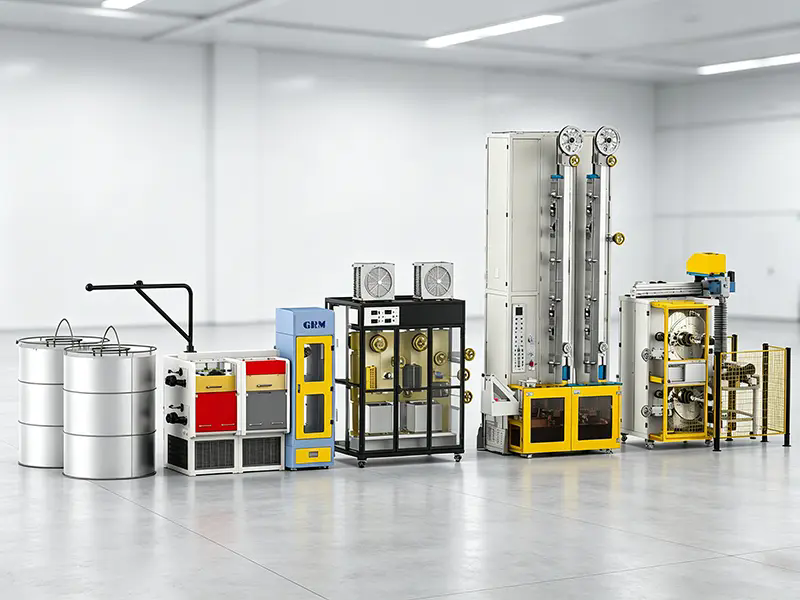
Table of Contents
- 1. The Physics of Copper Conductivity: Why Microstructure Matters
- 2. What Happens Inside the Copper During Annealing?
- 3. Key Process Parameters of the Solar PV Ribbon Machine Annealing Furnace
- 4. How Annealing Affects Mechanical Properties and Long-Term Reliability
- 5. Quantifying the Conductivity Improvement: From Lab to Production
- 6. Frequently Asked Questions (FAQ)
- 7. Conclusion
1. The Physics of Copper Conductivity: Why Microstructure Matters
The electrical conductivity of copper is not a fixed property; it depends on the metal's microstructure. In a perfect copper crystal, electrons would flow freely through the lattice, and the conductivity would be extremely high. In real copper, the flow of electrons is disrupted by scattering events. Electrons scatter off phonons (thermal vibrations of the lattice), off impurities, and off crystal defects such as grain boundaries, dislocations, and vacancies. Each scattering event reduces the electron's mean free path, which is the average distance it can travel before being deflected. The shorter the mean free path, the lower the conductivity. The goal of annealing is to increase the mean free path by reducing the density of scattering centers.
The relationship between conductivity and microstructure is described by the Matthessen rule, which states that the total resistivity of a metal is the sum of the contributions from different scattering mechanisms: resistivity due to thermal vibrations, resistivity due to impurities, and resistivity due to defects. At room temperature, the thermal contribution is fixed. The impurity contribution is determined by the purity of the copper. The defect contribution—including grain boundaries, dislocations, and vacancies—is the one that annealing can control. By reducing the density of these defects, annealing directly reduces resistivity and increases conductivity.
The table below summarizes the contribution of different scattering mechanisms to the resistivity of copper ribbon.
| Scattering Mechanism | Contribution to Resistivity (relative) | Can Annealing Reduce It? |
| Thermal vibrations (phonons) | Major (temperature dependent) | No |
| Impurities (foreign atoms) | Minor to moderate | No (requires purification) |
| Grain boundaries | Moderate | Yes (grain growth) |
| Dislocations | Moderate | Yes (recovery and recrystallization) |
| Vacancies | Minor | Yes (recovery) |
| Stacking faults and twins | Minor | Partially |
At Jiangsu Goodroller Machinery Co., Ltd., our Solar PV Ribbon Machine is designed to deliver the precise thermal profile needed to minimize the defect contribution to resistivity. The annealing furnace is not just a heater; it is a metallurgical processing tool that transforms the microstructure of the copper ribbon from a stressed, defect-rich state to a relaxed, highly conductive state. The next section will explain exactly what happens inside the copper during this transformation.
2. What Happens Inside the Copper During Annealing?
The annealing process in a Solar PV Ribbon Machine occurs in three overlapping stages: recovery, recrystallization, and grain growth. Each stage involves a distinct set of microstructural changes, and each contributes to the improvement in conductivity. Understanding these stages is essential for optimizing the annealing parameters in the ribbon machine.
Stage 1: Recovery. During the initial stage of annealing, the temperature is raised to a level where the atoms in the copper lattice have enough mobility to rearrange themselves. The primary change during recovery is the annihilation of point defects (vacancies and interstitials) and the rearrangement of dislocations into lower-energy configurations. The dislocations form cells or subgrains, and the density of dislocations within the subgrains decreases. This reduces the scattering of electrons and improves conductivity without changing the overall grain structure. Recovery occurs at relatively low temperatures, typically between 150°C and 250°C for copper.
Stage 2: Recrystallization. As the temperature increases further, typically to 250-400°C, the microstructure undergoes a more dramatic transformation. New, strain-free grains nucleate and grow, consuming the old, deformed grains. The dislocation density drops by several orders of magnitude. The grain structure is completely renewed. This stage has the most significant impact on both conductivity and mechanical properties. The new grains are equiaxed and free of the internal stresses that were introduced during drawing and rolling.
Stage 3: Grain Growth. After recrystallization is complete, further heating causes the new grains to grow larger. This reduces the total grain boundary area, which further reduces electron scattering and improves conductivity. However, excessive grain growth can reduce the mechanical strength of the ribbon, so the annealing process must be optimized to balance conductivity and mechanical performance. The table below summarizes the temperature ranges and microstructural changes for each stage.
| Stage | Temperature Range (°C) | Microstructural Changes | Effect on Conductivity |
| Recovery | 150 - 250 | Point defect annihilation, dislocation rearrangement | Moderate improvement |
| Recrystallization | 250 - 400 | New grain nucleation, dislocation density reduction | Significant improvement |
| Grain Growth | 400 - 600 | Grain boundary area reduction | Further improvement |
In our Solar PV Ribbon Machine, the annealing furnace is divided into multiple zones, each with independent temperature control. This allows us to create a precise thermal profile that takes the copper through each stage in a controlled manner. The ribbon enters the furnace at ambient temperature, is heated to the recrystallization temperature, held at that temperature for a specific time, and then cooled at a controlled rate. The entire process takes place in a protective atmosphere to prevent oxidation. This level of control is what enables our Solar PV Ribbon Machine to produce copper ribbon with optimal conductivity and mechanical properties.
3. Key Process Parameters of the Solar PV Ribbon Machine Annealing Furnace
The effectiveness of the annealing process depends on the precise control of several key parameters. These parameters interact with each other, and changing one often requires adjusting the others. The following are the most critical parameters for the annealing furnace in a Solar PV Ribbon Machine.
Temperature Profile: The temperature profile defines the temperature of the ribbon at each point along the furnace. It includes the heating rate, the peak temperature, the soak time, and the cooling rate. The peak temperature determines which microstructural changes occur. For copper ribbon, the peak temperature is typically in the range of 300-500°C. The soak time at peak temperature allows the recrystallization and grain growth to complete. The heating and cooling rates must be controlled to avoid introducing new stresses.
Atmosphere: The annealing atmosphere prevents oxidation of the copper surface. Even a thin oxide layer can significantly increase contact resistance and reduce the performance of the ribbon in the solar cell. The atmosphere is typically a mixture of hydrogen and nitrogen (forming gas) or pure nitrogen. The hydrogen content helps to reduce any residual oxide on the copper surface. The oxygen content must be maintained below 10 ppm to prevent oxidation.
Ribbon Speed: The speed at which the ribbon travels through the furnace determines the residence time at each temperature. A slower speed increases the soak time, allowing more complete recrystallization and grain growth. However, it also reduces the production rate. The speed must be optimized to balance productivity and quality.
Ribbon Tension: The tension on the ribbon as it passes through the furnace affects the grain growth and the final mechanical properties. Too much tension can inhibit grain growth and introduce new stresses. Too little tension can cause the ribbon to wander or sag. The tension is carefully controlled by the payoff and take-up systems.
The table below provides a summary of the key process parameters and their typical operating ranges for a Solar PV Ribbon Machine.
| Parameter | Typical Range | Effect on Conductivity |
| Peak Temperature | 300 - 500°C | Determines recrystallization and grain growth |
| Soak Time | 2 - 10 seconds | Longer soak improves conductivity up to a point |
| Heating Rate | 50 - 200°C/s | Controlled to avoid thermal stress |
| Cooling Rate | 20 - 100°C/s | Controlled to avoid quenching stresses |
| Atmosphere (Oxygen Content) | < 10 ppm | Prevents oxidation and contact resistance |
| Ribbon Speed | 10 - 40 m/min | Determines residence time and production rate |
| Ribbon Tension | 5 - 20 N | Affects grain growth and mechanical properties |
At Jiangsu Goodroller Machinery Co., Ltd., our Solar PV Ribbon Machine is equipped with advanced control systems that allow precise regulation of all these parameters. The furnace is divided into multiple zones, each with independent temperature control. The atmosphere is continuously monitored and controlled. The ribbon speed and tension are managed by servo-driven systems. This level of control ensures that every meter of ribbon produced on our machine meets the highest standards of conductivity and reliability.
4. How Annealing Affects Mechanical Properties and Long-Term Reliability
While the primary purpose of annealing in a Solar PV Ribbon Machine is to optimize electrical conductivity, the process also has a significant impact on the mechanical properties of the ribbon. These properties are equally important for the long-term reliability of the solar panel. A ribbon with high conductivity but poor mechanical strength will be prone to breakage during cell interconnection and during thermal cycling in the field. The annealing process must therefore be optimized to achieve a balance between conductivity and mechanical performance.
The mechanical properties of copper ribbon are determined by its grain structure. A fine-grained structure has high strength but lower conductivity because of the high density of grain boundaries. A coarse-grained structure has higher conductivity but lower strength. The annealing process allows us to tailor the grain structure to achieve the optimal balance for the specific application. For example, a ribbon that will be subjected to high mechanical stress during assembly may require a finer grain structure and higher strength, while a ribbon that will operate in a high-temperature environment may require a coarser grain structure and higher conductivity.
The annealing process also relieves the internal stresses introduced during drawing and rolling. These stresses can cause the ribbon to warp or curl during subsequent processing, leading to misalignment and poor contact with the solar cell. By relieving these stresses, annealing improves the dimensional stability of the ribbon, making it easier to handle and assemble. This is particularly important for thin ribbons, which are more susceptible to stress-induced deformation. The table below summarizes the effect of annealing on the key mechanical properties of copper ribbon.
| Property | Before Annealing | After Annealing | Effect on Reliability |
| Tensile Strength (MPa) | 350 - 450 | 200 - 300 | Lower strength but adequate for handling |
| Elongation (%) | 2 - 5 | 15 - 30 | Improved ductility, less prone to cracking |
| Internal Stress | High | Low | Improved dimensional stability |
| Grain Size (µm) | 1 - 5 | 10 - 50 | Improved conductivity |
| Conductivity (% IACS) | 95 - 98 | 100 - 102 | Improved current carrying capacity |
At our factory, we have conducted extensive testing to optimize the annealing parameters for different ribbon specifications. We have found that a controlled annealing process can increase the conductivity of copper ribbon by 3-5% while maintaining sufficient mechanical strength for reliable handling and assembly. This improvement translates directly into higher solar panel efficiency and lower power losses. Our Solar PV Ribbon Machine is designed to deliver this level of performance consistently, batch after batch.
5. Quantifying the Conductivity Improvement: From Lab to Production
The improvement in conductivity achieved through annealing in a Solar PV Ribbon Machine can be quantified using standard measurement techniques. The most common method is the four-point probe measurement, which measures the resistance of a known length of ribbon. From the resistance and the cross-sectional area, the resistivity can be calculated. The conductivity is the reciprocal of resistivity, and it is often expressed as a percentage of the International Annealed Copper Standard (IACS). Pure annealed copper has a conductivity of 100% IACS.
The following table presents data from our laboratory showing the conductivity of copper ribbon before and after annealing under different conditions. The data demonstrates that the annealing process consistently improves conductivity, and that the improvement depends on the specific parameters used.
| Sample | Annealing Temperature (°C) | Soak Time (s) | Conductivity (% IACS) | Improvement (%) |
| As-drawn (no anneal) | — | — | 96.5 | — |
| Sample A | 300 | 5 | 99.2 | 2.8% |
| Sample B | 350 | 5 | 100.5 | 4.1% |
| Sample C | 400 | 5 | 101.2 | 4.9% |
| Sample D | 450 | 5 | 101.5 | 5.2% |
| Sample E | 400 | 10 | 101.8 | 5.5% |
These data show that annealing can improve the conductivity of copper ribbon by up to 5.5% compared to the as-drawn condition. In a solar panel, this improvement translates directly into reduced resistive losses and higher power output. For a 500 MW production line, a 5% improvement in ribbon conductivity can increase the annual energy output by approximately 25 GWh. This is a significant economic benefit that underscores the importance of the annealing process in the Solar PV Ribbon Machine. At GRM, we work closely with our customers to optimize the annealing parameters for their specific ribbon specifications and production requirements.
6. Frequently Asked Questions (FAQ)
Question 1: What is the optimal annealing temperature for copper ribbon in a Solar PV Ribbon Machine?
Answer: The optimal annealing temperature depends on the specific copper alloy, the ribbon thickness, and the desired balance between conductivity and mechanical strength. For pure copper ribbon, the optimal temperature is typically in the range of 350-450°C. At lower temperatures, recrystallization may not be complete, and the conductivity improvement will be limited. At higher temperatures, excessive grain growth may reduce the mechanical strength of the ribbon. Our factory can provide specific recommendations based on your requirements.
Question 2: Why is a protective atmosphere needed during annealing?
Answer: A protective atmosphere is needed to prevent oxidation of the copper surface during annealing. At elevated temperatures, copper reacts readily with oxygen to form copper oxide. Even a very thin oxide layer can significantly increase the contact resistance of the ribbon, reducing the efficiency of the solar cell. The protective atmosphere, typically a mixture of nitrogen and hydrogen, displaces the oxygen and keeps the copper surface clean and oxide-free.
Question 3: How does annealing affect the mechanical strength of the copper ribbon?
Answer: Annealing reduces the mechanical strength of the copper ribbon while increasing its ductility. The tensile strength typically decreases from 350-450 MPa to 200-300 MPa, while the elongation increases from 2-5% to 15-30%. This reduction in strength is acceptable for most solar ribbon applications, as the ribbon is supported by the solar cells and the encapsulant. The increased ductility is beneficial because it makes the ribbon less prone to cracking during handling and thermal cycling.
Question 4: Can the annealing process be used for other metals besides copper?
Answer: Yes, the annealing process can be used for other metals, including aluminum, silver, and gold. However, the optimal temperature and atmosphere will be different for each metal. Copper is the most common material for solar PV ribbon because of its excellent conductivity and relatively low cost. Our Solar PV Ribbon Machine is designed primarily for copper ribbon, but we can customize the annealing furnace for other materials if required.
Question 5: How does ribbon speed affect the annealing process?
Answer: Ribbon speed determines the residence time of the ribbon in the annealing furnace. A slower speed increases the soak time, allowing more complete recrystallization and grain growth, which improves conductivity. However, a slower speed also reduces the production rate. The optimal speed is a balance between quality and productivity. Our Solar PV Ribbon Machine is equipped with a servo-driven speed control system that allows precise adjustment of the ribbon speed to achieve the desired annealing result.
7. Conclusion
The annealing process in a Solar PV Ribbon Machine is a critical step in the production of high-performance photovoltaic ribbon. By precisely controlling the temperature, atmosphere, and residence time, the annealing furnace transforms the microstructure of the copper ribbon, reducing defects and increasing grain size. These microstructural changes directly improve the electrical conductivity of the ribbon, reducing resistive losses and increasing the power output of the solar panel. The process also improves the mechanical properties of the ribbon, making it more ductile and easier to handle. At Jiangsu Goodroller Machinery Co., Ltd., our Solar PV Ribbon Machine is designed to deliver the precise thermal profile needed to achieve these results consistently and reliably.
If you are looking to improve the efficiency and reliability of your solar ribbon production, our team is ready to assist you. We offer a range of Solar PV Ribbon Machine models with advanced annealing furnaces, precise atmosphere control, and servo-driven speed and tension systems. Contact us today to discuss your specific requirements and to learn how our technology can help you optimize your copper conductivity and overall production performance.
Contact Jiangsu Goodroller Machinery Co., Ltd. today to learn more about our Solar PV Ribbon Machine and how our annealing technology can enhance your production efficiency.